

(For a short version of this review, go here.)
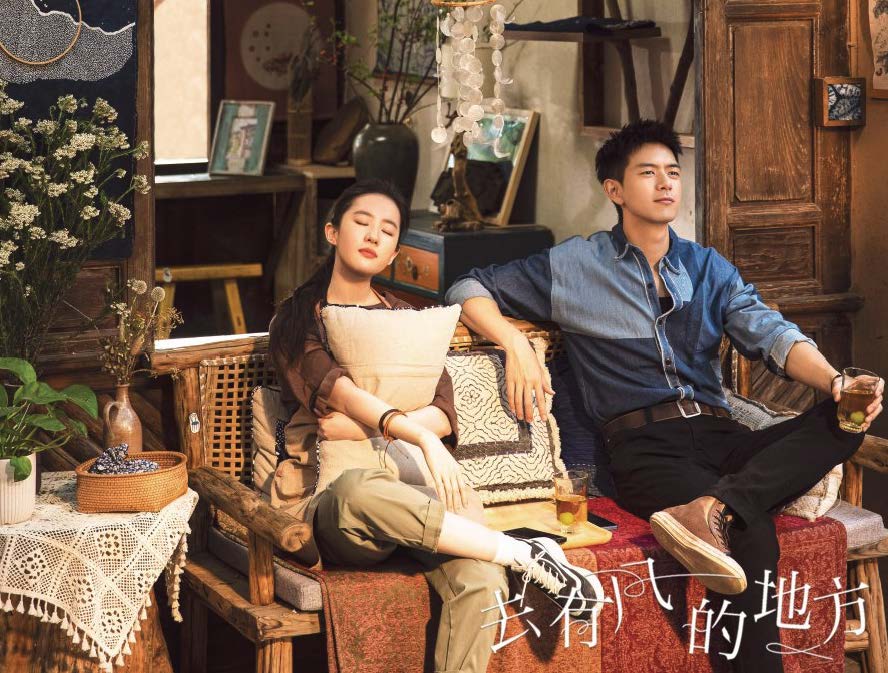
A slice of life drama with comforting vibes. It centers around a manager at a five-star hotel (Liu Yifei) who quits her job and takes time out in the countryside to reassess her life after her best friend dies unexpectedly. The young woman ends up sharing a homestay with a group of former city dwellers who try to escape the rat race and gets entangled with the local village beau (Li Xian). Their slow burn romance plays a minor part for the lion’s share of the show before it gets center-staged in the last few episodes.
Most of the drama takes place in a beautiful old village in Yunnan Province, set in a gorgeous landscape — just watching the scenery is already relaxing and feels like virtual green bathing. Village life is presented as rustic, authentic and slow — and so for our friends at the homestay there is always time for a chat or a walk, an opportunity to daydream or meditate. Just watching them, we slow down ourselves and happily spend time with these well-developed characters, listening to their often thought-provoking conversations and watching their relationships form. Lucky for us, acting and writing are top-notch so it never gets boring during the 40 episodes.
The misery of employees in big corporations is often shown in dramas but only rarely are solutions offered. This drama, however, gives us several role models who demonstrate how to get out of these situations. This is not done in a hitting-you-over-the head kind of way, which would compromise the multidimensional aspects of the characters. This show is too well written for that. Still, there’s clearly an underlying message for people considering leaving the big city behind.
For the characters who follow an artistic pursuit as a writer or musician, the village can be seen as a temporary escape from the expensive city. For musicians, however, the lack of audience and colleagues can turn life in a village into a dead-end unless they are willing to use their abilities to integrate into the community — as music teachers, for example.
Clearly the possibility favored in the drama to provide a realistic way out of the career rat race and switch to a quiet life in this gorgeous village is to become an entrepreneur — thereby not only finding a fulfilling and self-determined life yourself but at the same time improving the lives and prosperity of the village people.
While lifestyles with artistic pursuits, e.g. as a writer or a musician, are viewed non-judgmentally, one way of life pushes individualism too far and is criticized as foolish and egotistical: the pursuit of spiritual enlightenment. It is symbolized here by former CEO Ma Qiu Shan, who is portrayed as a ridiculous character who spouts existential platitudes. He finds the right way again (and hopefully we do too if we ever had such leanings) partly through his conversations with an uneducated working-class woman who is apparently grounded in the realities of life.
Technically, the writers are employing here a set piece of classic communist thinking: Religion is nothing but opium for the masses, workers are superior in their understanding of life compared to the educated class. However, quite different from its original intention, this argument is not used to restrain individualism in favor of a social class but in favor of a different social group, the family unit. And, in an ironic twist, this Marxist line of reasoning is employed in these scenes to encourage Ma Qiu Shan to found a new company — and thereby become a member of the capitalist class again.
Hunan TV, Mango TV. China. Written by Shui Qian Mo and Wang Xiong Cheng.
 dramaroma